

Which Magnesium Is Right for You?
A simple guide to the different forms, what each is best for, and the foods richest in magnesium
Magnesium supports muscle relaxation, nerve function and energy production, and many of us don't get enough. But "magnesium" on a supplement label can mean very different things. The form you choose changes how your body absorbs and uses it.
Here's a quick guide to help you choose:
Which form is best for you?
Glycinate Often chosen for: sleep, relaxation, general daily use
Gentle on the stomach
Citrate Often chosen for: Constipation, general top-up
Can loosen the bowels at higher doses
Malate Often chosen for: Muscle tension, low energy
Often taken in the morning
Threonate Often chosen for: Focus and mental clarity
Usually the most expensive
Oxide Often chosen for: Budget option
Poorly absorbed, more likely to upset the stomach
Food first
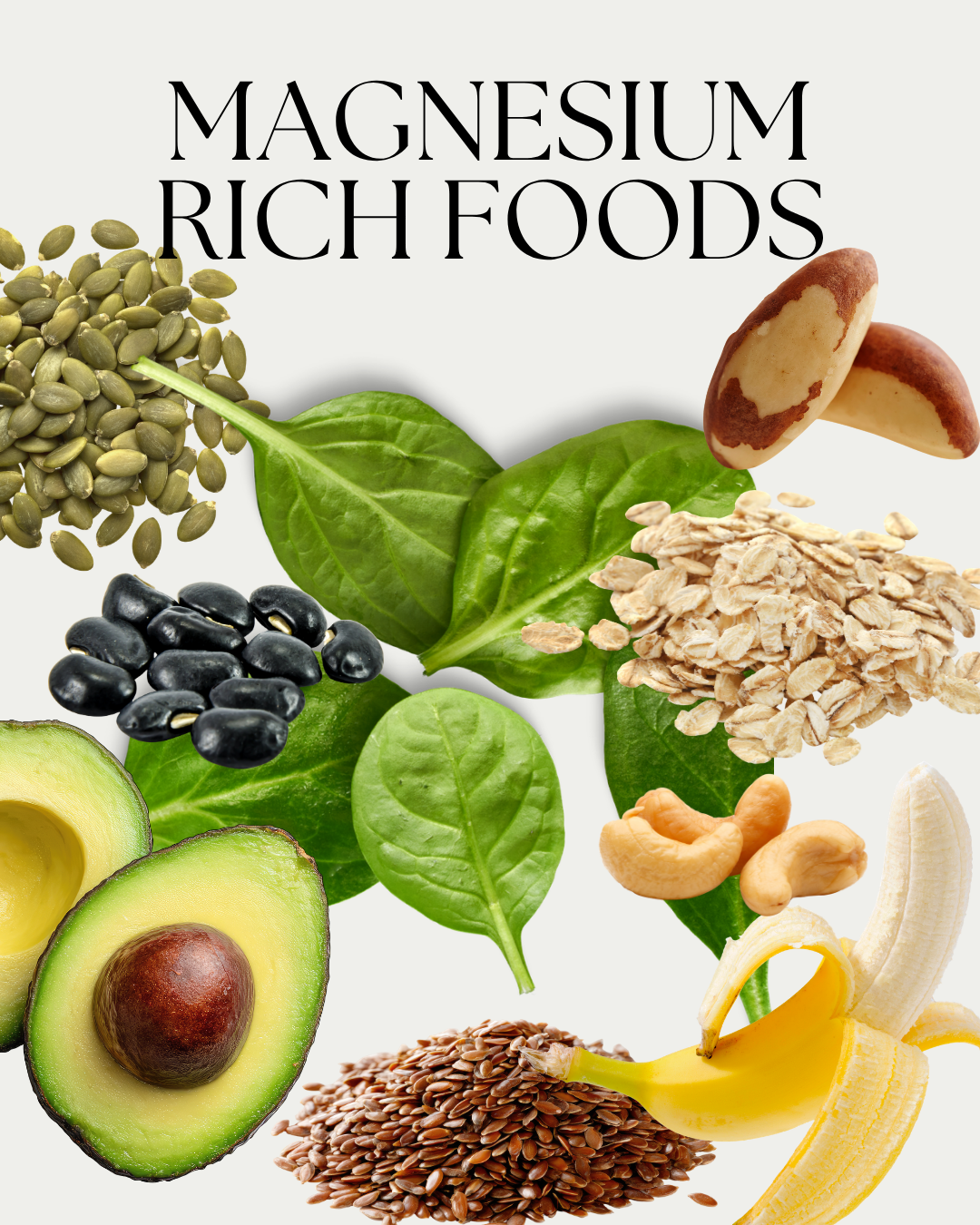
Before reaching for a supplement, look at your plate. Magnesium-rich foods, roughly from most to least concentrated per 100 g:
Pumpkin seeds (pepitas)
Flaxseed
Brazil nuts
Sesame seeds
Chia seeds
Sunflower seeds
Cashews
Almonds
Dark chocolate (70-85%) and buckwheat
Peanuts
Rolled oats
Tofu
Spinach and silverbeet (cooked)
Black beans and edamame
A small handful (30 g) of pumpkin seeds gives about 160 mg. Add chia to your breakfast, swap in almonds as a snack, and add a cup of cooked greens to dinner.
How much do you need?
In Australia, the recommended daily intake is about 310-320 mg for women and 400-420 mg for men. Most people can get close through food, with supplements filling any gap.
Before you start a supplement
Magnesium isn't right for everyone. If you have kidney problems, take regular medications, or are pregnant or breastfeeding, check with your doctor or pharmacist first. Too much can cause loose stools, nausea and cramping.
NHMRC and NZ Ministry of Health. Nutrient Reference Values for Australia and New Zealand: Magnesium. This supports the daily intake figures (about 310-320 mg for women and 400-420 mg for men). https://www.eatforhealth.gov.au/sites/default/files/2022-04/n35-magnesium_0.pdf
Walker AF, Marakis G, Christie S, et al. Mg citrate found more bioavailable than other Mg preparations in a randomised, double-blind study. Magnesium Research. 2003;16(3):183-91. This is a 46-person trial finding citrate and amino-acid chelate (glycinate) were absorbed better than oxide. https://pubmed.ncbi.nlm.nih.gov/14596323/
Gröber U, Werner T, Vormann J, Kisters K. Myth or Reality: Transdermal Magnesium? Nutrients. 2017;9(8):813. https://www.mdpi.com/2072-6643/9/8/813
Not sure which is right for you?
Everyone's body, training load and symptoms are different. If you'd like help working out what suits you, you may book online here in Mona Vale here.
Private bookings are now also available in Bayview- click here
Looking forward to seeing you soon,
Katie Halakas
Chiropractor, Mona Vale
katiehalakas.com
This blog post is general information only and isn't a substitute for individual medical advice.